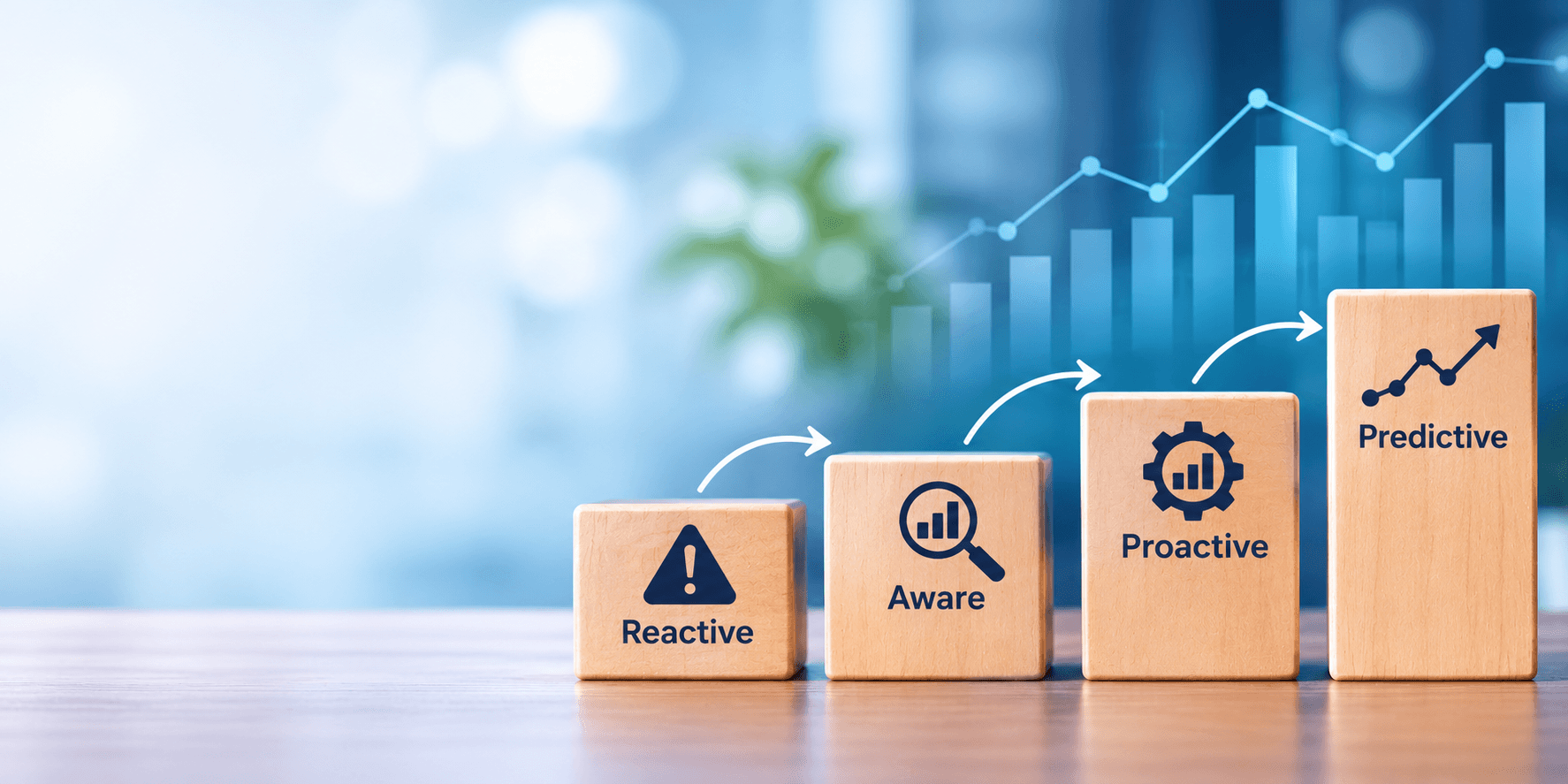
Every business collects data, but not every business can use it effectively. Getting a number quickly, trusting it, and acting on it without arguing over whose figures are right is not always easy. That gap is what we mean by data maturity, and it exists on a sliding scale. Most businesses aren’t at one extreme or the other; they’re usually somewhere in between, further ahead in some areas than others.
It’s not a measure of how much data you have, or how expensive your tools are. Two businesses can own the same BI platform and still be at very different stages of data maturity. One may get reliable, useful insights because its data is clean and consistently defined; the other may struggle because the platform is fed by the same messy, inconsistent processes that existed before the dashboard. True maturity comes from having data collection, storage, reporting and governance working together, and importantly, having people who trust the results.
Why it’s worth knowing where you stand
Knowing your data maturity stage helps in two ways. First, it shows where the next improvement will pay off; a business drowning in disconnected spreadsheets gains more from consolidating its numbers than from buying predictive analytics it isn’t ready to use. Second, it gives a shared answer when someone asks “why does this keep taking so long” or “why don’t these two reports match”; instead of being a mystery each time, it’s a known stage with a known next step.
The real return comes from better decisions: avoiding unnecessary freight costs because an issue was identified earlier, preventing overstocking because inventory data is more reliable, or spotting a problem before it affects customers. Those improvements add up as a business progresses through the data maturity stages.
Most businesses fall somewhere within the following four stages. None of these stages is a verdict on how well the business is run overall. A reactive business can still be profitable, well-managed, and growing. The stages simply describe how much friction exists between having the data and acting on it.
Stage 1: Reactive
If getting a straight answer to “how are we actually tracking?” means someone disappears for half a day to pull numbers from three places, this is probably where you sit. Data collection varies from person to person. One person uses a spreadsheet, another keeps data in their inbox, and a third uses a system no one else logs into. There’s no shared method for capturing data and no single place it lives. When two people look for the same figure, they often come back with different ones, and no one notices until it causes a problem. Reporting, where it exists, usually only gets pulled together when someone asks for it, rather than something people check regularly. By the time an answer exists, the moment to act has often passed.
What helps from here:
- Pick the two or three metrics that drive decisions, and agree on exactly where each one lives and how it’s calculated.
- Get those figures into one place, even manually at first. Consistency matters more than complexity at this stage.
- Write down who’s responsible for each data point, so “which spreadsheet is current” stops being a recurring question.
Stage 2: Aware
Reporting exists here - there's a CRM, a dashboard, maybe a data warehouse - and most people know where to look. The business has moved beyond collecting information in disconnected spreadsheets, but the systems aren't necessarily talking to each other effectively. The challenge is no longer finding the data; it's knowing whether the numbers are accurate and consistent enough to rely on.
What helps from here:
- Consolidate what exists into one source of truth, rather than adding another tool on top of those you have.
- Standardise how key figures are calculated, so “revenue” or “active clients” means the same thing in every report.
- Build in validation at the point data enters the system, instead of catching errors after the fact.
Stage 3: Proactive
The technical groundwork is largely done here: data is centralised, dashboards are live, and the business generally trusts what it's looking at. Data is being used to identify trends, spot emerging issues and inform decisions, rather than simply report on what has already happened. The remaining gap is turning those insights into consistent action across the business. While this is a good position to be in, relying on people to notice changes, interpret what they mean and follow through manually can limit how quickly the business responds.
What helps from here:
- Build alerts or triggers from the data itself, so action doesn’t wait for someone to look.
- Push reporting into the tools people already use daily, rather than a separate dashboard they must remember to check.
- Start training frontline teams, not just leadership, to read and act on the data relevant to their own work.
Stage 4: Predictive
Very few businesses we talk to operate here, so if this describes you, that’s a genuine result. Data doesn't just get reported on; it helps the business anticipate what's coming, forecast outcomes, and make more informed decisions. In some areas, predictive models and automated processes are already triggering action, supported by governance robust enough to make that safe at scale.
What helps from here:
- Keep governance and access controls scaling alongside the data, not lagging.
- Treat the systems driving automated decisions with the same scrutiny as the decisions themselves - audit what the automation is doing periodically.
- Plan for succession: ensure the knowledge behind the models and pipelines isn’t held by one person.
Why businesses get stuck between stages
Moving up a stage is rarely just a technology problem. More often, progress stalls because of internal processes, unclear ownership or a lack of adoption. Four common sticking points are:
No one owns the data
Data quality is everyone's job in theory, but no one's in practice. Without clear accountability, data maintenance and cleanup get deprioritised as soon as something more urgent comes along.
The solution: Assign a named owner to each key data set or report, even if it's only part of someone's role. Make them accountable for its accuracy and ongoing maintenance, not just access to it.
Projects are called finished too early
Consolidating or cleaning data doesn't produce a visible result like a new dashboard, so it's tempting to call the work "mostly there" and move on before the foundations are in place.
The solution: Agree on a concrete, measurable definition of done before the work starts. For example, "every active customer record validated against the CRM". This creates a clear distinction between finished and close enough.
Existing tools are stretched beyond their capabilities
A system designed for one job gets pressed into reporting or analytics duties it was never intended to handle. Over time, these workarounds can limit how far data maturity can progress.
The solution: Audit which systems are being used outside their original purpose and identify where they're creating limitations. Budget for the right tools before temporary workarounds become permanent infrastructure.
Change outpaces training
New dashboards and processes are rolled out faster than people can get comfortable with them. Even when the technical work is complete, adoption stalls and employees often revert to familiar ways of working.
The solution: Build training and adoption time into the project timeline from the beginning. Getting people comfortable with new tools and processes is just as important as getting the technology working.
Where does your business sit?
A quick way to get a clearer answer: our data-maturity-quiz asks six questions covering the areas above: collection, storage, reporting, trust, day-to-day use, and governance. Get a result on the spot, no email required.
Wherever your business sits, understanding your current level of data maturity is the first step towards making better use of the information you already have. If you'd like help identifying where to focus your efforts, talk to us about what the next stage could look like for your business.